Thanks

20130611-212233.jpg

Thanks to all of you who offered comments on your view of church.

I offered them to the class and they added great texture to our already interesting discussion. A few comments on where our weeklong discussion left us.

1. History matters – and not just the past decade. Putting our view of church in the context of church across time is fruitful, and necessary. Each era has had their own struggles and opportunities for discerning what it means to be church.

2. Church is both event and community – not either/or. God does break into our lives, into humanity, and change our human gatherings into divine spaces. For Lutherans, this in breaking comes in the form of Word and sacrament. But church is also a dynamic community of GOD’s called and sent people living in and for the world. Being a Christian public leader means attending to both of these dimensions of church.

3. Institutional structures flow out of the church’s nature and ministry – not the other way around. Hence, this means structures need to be revisited and reimagined. Said differently, the way church organizing itself needs to change over time. Our’s is one such time.

4. Being church is simple, and complex – and that is both a joy and a challenge. At it’s core, church is simple. It’s GOD’s people on earth being the body of Christ post-resurrection. Our work is to discover a Christian way of life and participate in GOD’s creative and redemptive mission in the world. And that is universal across time and place, as it is also particular to each time and place. The language, practices, and rituals of the church serve that call.

So, there you have it – some thoughts which bubbled up from a group of 12 leaders willing to ask hard questions and open themselves to GOD’s call to serve.

Terri

Spent the day talking about church

20130604-215138.jpg

Spent the day talking about church. The setting – 2nd day of a 5 day intensive course. Twelve masters students in the class, all serving as Christian public leaders in some capacity.

The day started with a seemingly easy assignment…in a few sentences write your definition of church. Answers included – being the body of Christ or living community. The church’s call to the world was acknowledged, as was the church’s role in shaping both our identity and our actions. Students named the core work of our Lutheran tradition as proclaiming GOD’s Word and administering the sacraments. And at one level, our task for done. The group had done great work. And it was only 30 minutes into an 8 hour day on this subject and they’d offered good stuff.

But, since they’d paid for the class and I had planned various activities and lectures, we decided to continue. Next on the order for the day was ‘opening our imagination.’ We listened to two songs which portrayed very different views of church. Great discussion followed, both naming realities and inviting reflection. Then we moved to our own experiences of church. More diversity surfaced and conversation deepened. Then we wondered what Scripture had to say, what our denomination had to offer, and ended the morning wondering what views of church culture offers. Now, 3 hours later, the earlier definition we offered somehow seemed too simple for the complex world in which we find ourselves.

If you were asked to participate in this exploration, what would you say?

If we scan history we get a really big view of church. And in doing so our view of church gets both bigger and smaller. Here’s what I mean. Some of our current ‘givens’ might not be so necessary. (For example, we had a great conversation about what people thought of the organ in worship when it was first introduced! Or wonder what people thought about using bar tunes as hymns!) And some of our ‘auxiliaries’ might be more essential. (Things like caring for one another and seeing that the needs of our community, internal and external, are attended to.) We might also wonder about things like location and leadership, things like passing on practices across time and learning the Christian story, about how (and when) we connect faith communities and the place our theological commitments have, and we might wonder what it means to faithfully witness to GOD’s love in our time and place. These wonderings have not been easily answered in other eras. Truth is, they probably won’t be in our either. But history does offer some perspective, if we step back far enough.

What do I know? I know my view of church has gotten simpler, and more open to possibilities. I know God loves the world and all humanity. And GOD’s mission of loving the world includes inviting the church, GOD’s people gathered and scattered, into that work. I know that calling includes communities of people located in particular places, a geography if you will. But I also know it includes people or groups sent out, mobile units or people with particular foci or ministries. I know being the church includes some practices, and I’ve come to believe that being church includes a lot of improv. And much of the rest is a mystery. And I’m OK with that.

What about you, what do you know?

We pick this topic up again on Thursday. We left class with our definitions intentionally messy and unresolved. Live with us in the tension. Offer your ideas (I’ll offer them to the class), and I’ll post again on Thursday and let you know how it goes.

Terri

What does it mean to be Church today?

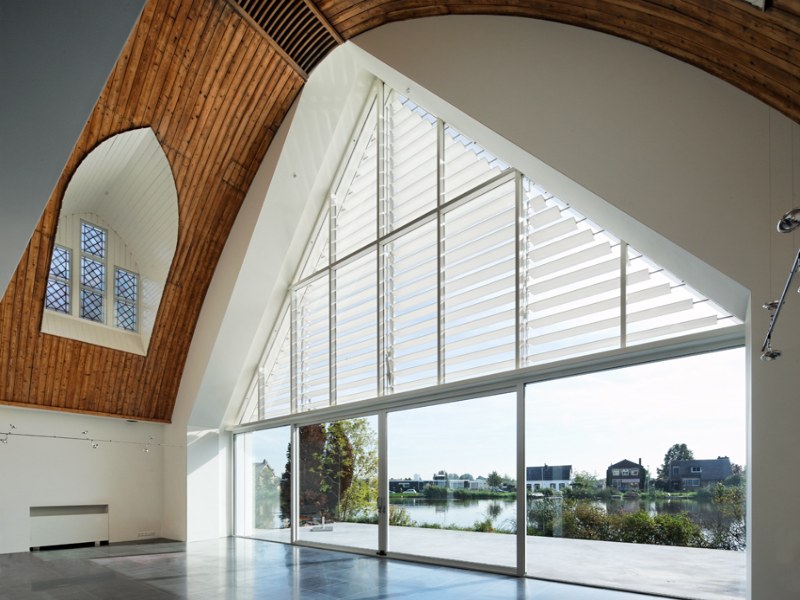
Kerkje Hillegersberg. Architect: Ruud Visser. Cell. +31(0)654723600
Today I sit at a bagel shop grading papers – papers by seminary students regarding ministry and leadership. All semester we have been wrestling with what it means to be “a church for the world.” We’ve looked at research, studied texts from various faith traditions, worshipped together in various forms, discussed our own experiences and presented our own ideas, engaged various theories, and reflected on ourselves as Christian public leaders. At the beginning of the semester we wrote simple definitions of church; at the end of the semester we have as many questions as answers. What does it means to be church in the 21st century?

As I read papers, there’s a buzz around me.
– There’s “the regulars” stopping in for their cup of coffee and breakfast bagel. They joke with the employees and head off to work or settle in to read the paper.
– There’s “the functional” crowd who stop by to grab a bite as they run errands or go about their daily routine. They don’t chat much or leave much of an impact as they come through.
– There are people, like me, “hanging out” working or studying. They grab a coffee or soda and quietly sit in a corner, immersed in their own world.
– Then there’s “the socials.” They’ve come to meet up. Some are friends, you can tell, and they quickly pick-up where their last conversation ended. Some are family, like the grandma having a morning treat with her grandkids, simply enjoying each other’s company. Some are college students, beginning their summer break by reconnecting after months or weeks apart. They stroll in closer to lunch and are sporting their favorite college sweatshirt.
– And today, due to the rain, some are “the outdoor workers.” Two or three groups made their way through, grabbing a snack as they wait out the weather. They chat as they hope for the weather to change, wondering how this will impact their work. One of these groups sat behind me and reminded me why we have to wrestle with being church today.

Here’s the scene. Three damp painters, all “younger” men, grab a bagel and a booth. A few minutes later, a young woman (not a painter) comes and joins them. I soon realize she’s married to one of the painters, the one who is probably the foreman or boss. Since there’s no rush, as it’s still raining, they just chat – sharing a bit about their life stories. One of the men shares how he’s moved around a lot, has family all around, and isn’t much into long-term relationships. Then he shares about his family. His father, who died when he was 10, was from a family of partiers. His mother’s family were church goers. They ask more questions and he acknowledges he didn’t go to church much, and in fact was not even baptized. Then, seeming out of nowhere, the couple talk about their day trip canoeing on Saturday. It’s with people from their church, and without missing a beat, they invite him along. And he says yes.

OK, so go figure – faith and life conversations happening right here in the bagel shop! Then three more crew members join them, as well as another young girl. And interesting enough, they continue this conversation. And, as the rain stops, one by one the painters leave. The two women remain, with the married woman seemingly “counseling” the other. Prayers, reading scripture and discerning how to live a life of faith the core of their conversation; it’s not in a cheesy way, but as an authentic expression of care and concern.

What does it mean to be church today? Perhaps it means hanging out in bagel shops. Getting to know the people who pass through and supporting those who stop and engage. Perhaps it’s reimaging our call from the outside in. Ministry is happening in the world. Intergenerational conversations, young adult community, friendly-faces offering encouragement for the day, space for connecting with old friends, and a place in the community to work. And maybe, just maybe, we too could be – should be – moving our conversation about faith and life into such public environments.


I Saw What I Saw

Video

Yesterday I received a text from my husband. Attached was a picture of a child. Today I received another text, saying great program and great stories.

Not that rare, but these texts were different. You see Eric is traveling in Ethiopia with a group from Compassion International. This is not his first trip to Africa, but that doesn’t matter much. The pictures spoke volumes. Trips like this have the potential to change us. You see Eric and I have been sponsoring children through Compassion International for over 20 years. And we’ve been lucky and had the chance to meet all three of our children, now all out of the program. So today’s experiences are added into a whole array of other meaningful moments connected to how Compassion International is making a difference in the lives of young people around the world.

While Eric was in Africa, I was working in St. Paul, MN, preparing for graduation this weekend. Tomorrow and Sunday I will have the opportunity to witness over 120 ministry leaders receive their diplomas marking the final step in their journey at Luther Seminary. Students assembled will be from all sorts of places like Minnesota, Ohio, California, and Florida, and sent to similar places. A significant number, however, have come further than that. These students, mostly sent by their home churches, crossed continents and oceans to get here. They left families and supporting communities to follow their call. And now, after years of being separated from the ones they love, will be sent out to change the world. Some will return to their home countries immediately, others will make some stops along the way. But all of them will make a difference in one way of another.

As I hear the names of these student read and watch them walk forward, tears will come to my eyes. My heart will be filled to brim, and I will be without words. You see these leaders in ministry have changed me. They have brought the world to me – both it’s pains and it’s joys. And I see their communities, their families and friends, through them. And, like Eric, I will have traveled a long distance and been changed.

There is no way our family can thank these ministry leaders, near and far, for making an impact in our lives and ministry. You have changed our family and our calls. And we cannot see the world the same any more. Thank you!

Sara Groves song, sums it up best.

Social Media and You

I don’t think social media is dangerous. I think we are dangerous.

Social media is here to stay, just like telephones and computers. Yes, there are unhealthy ways to interact with social media. But there are also healthy ways to engage social media. For those of us seeking to be public about our faith, social media is one place to engage public conversation – be it about social issues or our personal lives. I, for one, have appreciated having social media tools available to me as I stay connected in meaningful ways with various people within my social sphere. Sometimes it’s with people down the street, other times it’s with people halfway around the world. Sometimes it’s sharing information, other times it’s lamenting the loss of my favorite sports team. Regardless, I want us, everyday people, to wonder how faith and social media might intersect in a constructive way. Check out this great, simple article on ways social media can be a healthy way for humans to live within community.

How Social Media Made me a Better Person

Link

The importance of Family Meals

Family Meals Remain Sacred in the Face of Splintered American Lifestyle

Many of us grew up with meal time as “sacred” time for family. Some of us liked it, others of us hated it, but most families did some version of it. Today shared family time around a meal is not the norm. But studies say it’s a health practice. Our family still does value time shared around meals. Sometimes friends join us, sometimes it’s chaotic, and sometimes we do it in public places. I love this project on reimagining this simple, but core practice. Check it out!