and the floors need to be mopped

s_632

It’s been a week since I pulled into my garage. As I walked into the house and set down my bags, I headed to the kitchen continuing the conversation my husband and I started in the car. “How’s work?” “Talked to the kids?” “What time will you be home from your meeting?” As I sat in the stairway I got a panoramic view of the house – the living room, dining room, kitchen. The floors need to be mopped, I thought.

Today I returned from Detroit were 1,050 church leaders connected, learned, and supported each other in our shared call to children, youth, and young adult ministry. Many were friends and colleagues I anticipate seeing year after year. I treasure our relationships and am amazed at how quickly hotel hallways can become holy spaces. Others were past students, now well established in ministry roles around the country. It is a pleasure to be partners in ministry with them. And other faces were unfamiliar only days ago and today their stories echo in my heart. Their stories express the joys and sadness of leading ministry in 2015.

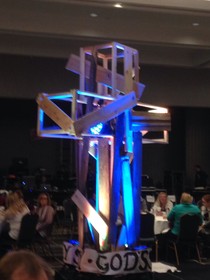
Art, drama, song, worship, teaching, and conversation embedded the theme of story into the rhythm of each day and night. Rachel Kurtz’s “Make a Difference” made the group “Rise Up” as her voice and the melodies filled our souls. The gospel of Mark came alive as Phil proclaimed it in front of “the big book” Nate and Katelyn illustrated. Liz preached, Todd welcomed, Nikki prepared, Dawn orchestrated, and Chris, Tom, and Tim produced. The rugged, boxy cross and phonograph baptismal font claimed the ballroom, and us. And each day as characters stepped in our “theatre in the round” a room was transformed, and the lost were found. The story lives and moves inside us.

As my husband left, the house quieted and I went to get the mop and the broom. Almost Cinderella-like, I went about my cores as my mind wondered about my friends and the future. “Did our students make it home safely?” “What will come of my new friendships?” “What will next year be like?” “What time is it in our church?” “What do I do with this?” Seeing the new blanket of snow falling outside, I’m hopeful flights continue getting people home. Then the washing machine buzzer sounds; time for another load.

Many hands and minds make a gathering like this possible, and makes evident the claim, “many hands make light work.” But this gathering is not just about an event. It is not even just about growing as leaders. It’s about the church. It’s about people telling God’s story even as they tell a bit of their own.

Tomorrow I, like many others, will return to my “ordinary” work. Classes to teach, confirmation to prepare, sermons to write, retreats to plan, expense reports to complete, emails to return. The list will be long, the demands great, and the energy low. Then, after a full day of work, I, like many, will enter a church building and sit among Kentons, Alexes, Jakes, Jonahs, Justins, and Davins – with all the energy and curiosity 7th grade boys can bring. We’ll ask each other about our week. I’ll hear about soccer and basketball and math tests and siblings. They’ll hear about Detroit, getting 16 inches of snow, and what it’s like watching the Super Bowl with several hundred other people. And in the midst of telling our stories we will tell God’s story.

Perhaps big things will come of this week in Detroit. Some may have sensed a call to ministry, decided to take a new job, committed to go to seminary, or met the person they will marry. I hope the Spirit moved in such profound ways. But perhaps this week in Detroit has as much to do with the ordinary things – our to-do lists, conversations with our friends and family members, healing our hearts, reminding us we are not alone, and, well, mopping the floors. Tomorrow as I head off to work, I will hold this past week in my heart and pray my eyes are open to see God’s story in the people I encounter. Perhaps you will too.

#ext15

A visit to South Carolina

I’m wrapping up my time in South Carolina. It has been a great opportunity to teach seminary students located in a different region of the country. I have learned from them in class, I have discovered a bit of South Carolina’s history, and I have even tasted some southern cuisine. It has been nothing but delightful to join another learning community, even if for a short amount of time.

In class we have been talking about, rather wrestling with, ministry with children in this time. So many forces are shaping children today – consumerism, digital media, social networking, athletics – and it can be overwhelming for parents and ministry leaders as they try to engage in faith practices and learn about God’s story. While we are ending with more questions than answers, a few things have surfaced:

1. Our identity as people of faith comes from God, not society. Ground kids, ground us all, in that promise. Our identity as children of God never changes. While the world wants to commodify life, tell us what to wear, try to influence our values, and turn us into objects, God claims us and makes us subject of God’s love. That’s pretty cool.

2. Subjects need to live in community. As subjects of God’s love that means living in a relationship with God and with other of God’s subjects. Being in Christian community we are reminded of our identity and of the one who loves us and created us. In community we are formed and shaped as subjects of God’s love. In community we are informed of who is God is, and we grow deeper in our love for God, ourselves, and the world. And in community we are transformed, made new and empowered to love and serve others. And that leads to…

3. As subjects of God’s love we are also agents of God’s love. Yes, we gather with other Christian periodically, but we spend most of our time scattered in the world. And when we are scattered in the world, we have a role to play. We are to embody God’s love in the world, we get to give God’s love hands and feet and hearts and ears.

What if, at the heart of ministry with children (and their families), we helped children know theses three things? What if we shared these ideas with words and actions? What if we helped families do this as well? I don’t know what a typical week would look like in our congregations, but I’d hope we’d be spreading God’s love in the world.

Oh yea, and we have a guest who joined us. Check this out.

It’s messy


1798654_10205754271757512_1603256457794686824_n

Isn’t it fun and mysterious when different parts of our lives, or a community, come together spontaneously? That’s what happened yesterday for me.

I’m teaching a class at a sister seminary. After class yesterday I joined the community for chapel. Leading chapel was the teacher, and friend, from another class down the hall. The focus was on our gospel text for this past Sunday, one this class had preached on as part of a class project. Living in the text for three days prior, engaging in the transforming ministry of a congregation in Knoxville, TN, they had these three reflections on baptism:

1) Baptism can’t be tamed – It wasn’t a reverent ceremony in a picturesque chapel with all the focus on the newly baptized when John baptized Jesus. Rather is took place in the wilderness, amidst the “less-than” sparkling clean Jordan River amidst a crowd of people. Maybe the “clean” we talk about in baptism is not as we imagine it.

2) Jesus jumps into the mix and wades into the muddy waters of the Jordan. And as he does the heavens are torn open and he is identified as the Beloved, as God’s son. And when he steps out of the river, maybe he wasn’t sparkling white surrounded by angels, but covered in the silt and gunk of a well-traveled, well-used river.

3) Baptism should come with a warning – “Buckle your seatbelt. Get ready for the ride of your life.” Through the waters of baptism, we are invited into a wild ride, a grand adventure into God’s wonderful, messy, marvelous world where God’s kingdom is breaking in? What if the messiness of our lives combined with the promises of God is a crazy combination in which young and old, rich and poor, the faithful and the doubters all are invited to be agents of God’s love? What if, just like Jesus, we emerge out of the murky waters not sparkling clean, but empowered for a mission?

That’s the sermon I heard yesterday. And our class was in the midst of being reminded we are not objects of this world, at the mercy of a consumer-driven culture, but subjects of God’s unrelenting love. And we, God’s subject, in the waters of baptism are filled with the Holy Spirit and become agents of God’s love. We, like Jesus, are invited into the mucky areas, the messy parts of life, of our world.

Today we will open class with this powerful song, Dive, by Steven Curtis Chapman. The images and words remind me, remind us, to dive into this wild ride every day.

Learning from the past…the importance of the local congregation

I spent the first 15 years of ministry leading congregational change from the location of a congregation. I attended to our issues, opportunities and concerns…but I had the joy of being in the midst of a larger conversation. Alban Institute, and Loren Mead, were key leaders in that conversation. This interview sheds light on what was happening in those years, and it makes we wonder what this means for us today.

Check this out…
interview with Loren Mead

Generosity—Attitude and Actions

Generosity is counter-cultural in today’s culture. And for those of us who value it and want to foster generosity in our families and faith community,  we quickly discover it is also hard to teach. But generosity is an important aspect of our call to be stewards. While generosity is most often tied to money, I think generosity is about all of life’s resources and is as much about an attitude as it is about actions.

Recently I had the opportunity to share some of my thoughts with the community of stewardship leaders connected to Luther Seminary’s Center for Stewardship. Check out my blog post (9-23-2014) as well as other great posts from other church leaders.

Center for Stewardship Leaders – Luther Seminary

New

back-to-school-pencils-edit

Some times new is obvious … like the smell of a new car, moving into a new house, or starting a new job.

Some time new is subtle … like one month rolling into another, getting a new pair of sneakers, or opening a new bank account.

Whether obvious, subtle or somewhere in between, celebrating the new is a good practice, and a spiritual one at that.

This past week I’ve lived through many new moments.         Maybe you have to.

Only a few days ago I dropped our youngest daughter off for her first year of college. New for her; new for me.

Today marked the first day of a new academic year, and the launching of a new day at our school. New presidential leadership and a new curriculum. New students starting; returning students entering a new world. New staff and faculty welcomed; all staff and faculty living in a new reality.

I have a new office, in a new building. This week brings a new routine and new set of “hallway conversations.”

Today I drove to work the same way, but in a new car. The same, but not the same.

And this evening I returned home where there was no “how was your first day of school” conversation at the dinner table. In fact, I ate dinner alone.


New is all around us: new jobs, new homes, new schools, new family members, new driver’s license, new calls, new chapter in your life, and new routines.

Newness is often accompanied with hope, but can also be connected to anxiety and uncertainty. Newness can be welcomed and smooth, it can be scheduled and planned, but it can also be disruptive, sudden, unsettling and “rock your confidence.”

Our new may be shared with a community or evident only to you. It may be private or public. There may be words to talk about how new impacts life, or it may be beyond words and only experienced in our gut.

Why celebrate the new? Because it matters! Just like I noted the importance of marking endings in a recent post, I think it is equally as important to celebrate the new. Why?

  1. Marking endings has an eye to the past. Celebrating new has an eye to the future. With an eye to the future new reminds us we are more than our past. Yes the past does shapes us, but we are not held captive to our past. This is both good news and bad news. As a great athlete knows, continuing to be “in the game” means showing up everyday. And showing up everyday is not only doing the basics, but includes trying new things and imagining new possibilities. In the moments of new we have a choice – to hold on to the past or to see a future on the other side. How does the new in your life provide the opportunity for you to see into the future? How does the new provide an opportunity for a bit of the future to come into your present?
  2. We celebrate the new because it reminds us we are “becoming” people. Think about it. Starting middle school or junior high is a moment of new. As scary as it might have been to start 7th grade it was just one in many steps from childhood to becoming an adult. Staying a kid isn’t an option, but how we move into the new is. Starting piano lessons or learning to ski are awkward at first, but stick with it and if we embrace the learning it can be fruitful. Over time, and with practice, we learn and move into our own way of becoming. We may or may not every become an elite skier or professional piano player, but learning, in and of itself, stretches and teaches us a variety of lessons. How does the new in your life remind you you are still a “becoming” person? How might you embrace those “becoming” moments?
  3. Celebrating new recognizes we have a God who makes all things new. Be it creating new or redeeming into new, God is all about making things new. So celebrating new is an opportunity to make room for God in our life, remembering and marking God’s activity among us in real time. Today, in a quick phone call with my new college daughter, she interrupted our conversation to share something with a someone in the room. I asked her who was there and your response, “a new friend. You wanted me to make friends, right?” What a welcome statement for this college mom to hear. How is God present in your new moments? How is God creating and/or redeeming in your life in the midst of new? Mark those moments with prayer.

Yes it is a season of new.

And yes we have a God who makes all things new.

Thank God for the new!

‘Tis the Season

‘Tis the season of transitions – endings and beginning, good-byes and hellos. Wrapping up “the school year.” Getting married. Moving. Graduating from college. Celebrating ordinations. Accepting new calls. Starting a new job. Having a baby. The list could go on. Endings and beginnings are all around us this time of the year.

In my life, transitions take the form of a high school and college graduation, preparing to move into a dorm and moving back in with mom and dad, wrapping up another academic year (and a curriculum) and anticipating teaching new classes in September, and wondering what it means to be in my 5th decade of life. (Could that really be true?) It means graduation parties and rediscovering daily routines. (How needs a car today? Is there enough food in the house? Did someone do the laundry?) It means intentional relational time and space to ponder the changes taking place. It means some days are exciting and other days are simply hard. Endings and beginnings are all around us and while they happen all year round, for many, this time of the year moves transitions from the edges of our lives to the center.

Living in the midst of transitions is chaotic, but there are things that are “normal” and there is work to be done. William Bridges reminds us that being tired, confused, and having a sense of “being lost” is all part of what’s normal. Endings require letting go, but letting go means saying good-bye to routines and patterns that order our lives. And letting go is hard, especially when the future is unknown. And even our most anticipated beginnings are accompanied with a sense of melancholy. Bridges reminds us to gives ourselves, and others, a break during times of transition.

But there is work to be done in times of transition. Letting go, releasing the past, is part of that work. Yet letting go does not mean erasing the past. Endings, be they graduations or a relational break-up, are simply markers. These markers are not in themselves good or bad, they just are. They note time and that patterns of the past will not be the patterns of the future. And marking time allows space for rethinking and recalibrating so we have the capacity for moving into something different, something new.

One of the pieces of relational wisdom I’ve shared with youth and young adults is: just because a relationship ends does not mean it wasn’t meaningful and/or was an important part of your life. We grow, we change, and we have new opportunities. Some experiences and friendships fit for a time, do us well for a chapter, or are meaningful for what they are/were. Camp, for example, is a good thing. But camp works because it is an experience bound by time. Living through endings, and saying our good-byes, doesn’t negate what was. In fact doing endings well actually honors what was. Having graduation parties, for example, honors the graduate, but it also recognizes the greater community and is an important part of the process of transition. Graduations (and graduation parties) mark time, allow us to remember what was, and in so doing it prepare us to move into a new future. Without tending to endings, all of the good aspects of what was can be overshadowed with the disorientation that accompanies transition and the fruitful memories of the past can be distorted.

Summers often are accompanied by navigating some type of transition. At our house this summer we are navigating more than normal. And we have moments when it is going well, and other times when it’s not. But we are doing our work – we are celebrating accomplishments and giving each other space to grieve; we are appreciating the little things, like reflective conversations while walking the dog, as we also are recognizing the big changes taking place. We laugh and we cry. We have time alone and enjoy time together.

I’m mindful of those in my circle of friends and colleagues who are in the midst of transition. Some anticipated and celebrated, others forced and disheartening. Today, I hold you in my prayers. May God meet you in your letting go, in your disorientation, and in giving you hope for tomorrow. And may you experience grace and peace, space to be alone and community with which to share the journey.

Terri

Church Meets the World

Usually I prepare for teaching locked away in my office surrounded by shelves of books and peace and quiet. Yesterday I prepared for teaching a class on Faith and Mission Practices by mingling among people of difference ethnic backgrounds, socio-economic status, and situations in life. Some were looking for something tangible – a bag of food, some “new” clothes, or relief from tooth pain. Some were present to serve – in planned and unplanned ways. All received hospitality, a listen ear, and Christian community.

The “result” of my day was captured in some short video testimonies which I complied into two short videos. These stories and pictures are just the tip of the iceberg of what a “day at the mission outpost” is all about. I invite you to listen in, but more importantly I invite you to think about your own faith and mission practices. How is God calling you into  Christian community and how is God calling you into the world?

Wired might open imagination for ministry

20140329-213248.jpg So I’ve often found myself sneezing a peek at Wired magazine. Most of it is over my head, or outside of my know-how. But every once and a while there are ideas which cause me to pause and … Perhaps get glimpses of ministry in the years ahead. Today I was wandering around Wired’s website and came across these two videos. Watch them and see what you think these might mean for ministry in the 21st century.