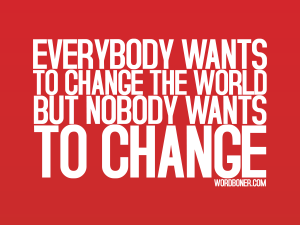
Immersed in Change

continue

My life has been immersed in change. I know, I know…I’m not alone. But jump in with me in reflecting on these moments, and let’s see if any leadership lessons on leading change emerge.

First work. A few weeks ago I was chatting with a new student about last fall semester and it suddenly occurred to me, last fall was a lifetime ago. We, Luther Seminary, are living through a series of one year anniversaries – dates on the calendar which remind us our course for the future has changed. In October our board had their regular fall meeting – and we remembered it was last October when the board discovered some financial concerns. In early November we quietly moved past the one year anniversary of the resignation of our CFO. And coming at the end of this semester will be the one year anniversary of our president’s resignation. I remember how tired I was in January and into the spring, but I had forgotten now much territory we had covered since December 2012. Talking with students who were not around last fall was a bit surreal. I remember living that life, but it seems like a distant memory now. Lesson: Huge, disruptive change disorients people and plays with their sense of time. Leadership Questions: After the “crisis” has passed, how do organizations regain a healthy sense of time? And how important is it to help people gain some perspective? What is the role of noting one year anniversary’s of significant moments in an organization’s history?

Second church. On Reformation Sunday our congregation concluded a year of celebrating our 50th anniversary. The past twelve months we had noted different memories of the past, different moments in history which marked key parts of our congregation’s story. And it all came to a head with a grand worship experience and some gatherings on the last Sunday in October. Facing my 50th birthday this summer, I realize the importance of reflecting on the past and taking account of the twists and turns of one’s story – personally and collectively. During the celebration I had the chance to share stories and catch up with many people, some I had not seen in awhile and others who I see but haven’t shared this deeply in some time. As the weekend ended and we started the next 50 years, two things crossed my mind: we don’t do this often enough and it matters what story we tell. As much as I treasured many aspects of the celebration, I also noted the key parts of the story which were not told – parts that were important to my almost 30 year experience there. Lesson: What story we tell matters. Leadership Questions: Who decides which story of an organization will be told? How do we tell the breadth and the depth? How do we share the joys and the challenges? How do we tell the story of the “old timers” and the “newbies”?

Third home. Our family has two seniors, one a senior in high school and the other a senior in college. And being a senior is a year full of change. There are celebratory endings – or series of “lasts” – and imagination about the future. There are moments which force you to appreciate the current chapter and moments which force decision about a future direction. There are anxieties and honoring. There’s community to journey with and there are moments when “no one understands.” Yes, all of those things are true, and often they are paradoxical. Being a senior has its good days and stressful days. And living with, trying to parent and support, two seniors has its own ups and downs. Yes I’ve been there, but this isn’t my journey. Yes I have experiences, but I can’t make other people’s decisions. Yes I know some things, but it’s not wise to let learning moment go unattended. Being the parent means I have to roll with the changes, but not get too drawn into them. Lesson: Leading people in change requires staying relationally connected while also not doing other people’s work. Leadership Questions: How are we balancing being relationally connected and only doing the work that is ours? Do we know our role? Do we know what the work is and who’s it is?

As I continue to live in the midst of change, I’m noticing I need moments to rest and to reflect. But I also need moments to grieve and let go. I’m trying to find a healthy way through all three of these scenarios. I know you have your own set of scenarios, and I hope these lessons and questions might help you discover both an accompaniment partner and some fruitful lessons for the journey.

Terri

Open Hands, Open Hearts

20130930-071432.jpg
Yesterday I was a guest preacher in a congregation I had never been to before. I entered as I do many congregation, a friendly stranger, but left with more than I had anticipated – with a deep sense of connection to God and insight into what it means to be the body of Christ.

On all accounts, this congregation was welcoming. Several people came to me and introduced themselves as I entered. Many talked with me afterwards, sharing a bit about their lives and their concerns. A young boy engaged me in conversation as he sold me a candy bar. If I was assessing their hospitality, this congregation would have scored high. Yet interestingly enough the most transformational part of my experience was not their hospitality, but rather came in an ordinary and unexpected moment.

In addition to preaching, I served communion. As is typical in many congregations, people came to the front of the Sanctuary and knelt at the communion rail. As they did they rested their open hands on the railing and waited to receive the bread and wine. Moving slowly from person to person, breaking off bread as I went, I placed a piece in their hand and said, ‘the body of Christ broken for you.’ Simple, traditional words which turned opened up an extraordinary experience. You see, as I placed the bread in their hands and said these words, my eyes moved from their hands to their face. As their eyes met mine, my heart was touched, softened, nudged. With each new person the experience became more personal. As I made my way, I noticed something…not only were their faces unique, but so were their hands. Each pair of hands had its own character, told it’s own story. Many of the hands were twisted as a result of arthritis. Some were the hands of laborers, big and rugged; others were refined, soft and polished. Some hands were the hands of children, others assisted the elderly. Yet all were open.

Our church, the ELCA, has lifted up a mantra, ‘God’s Work, Our Hands.’ One of the ways this mantra has come to life was with hundreds of congregations beginning this fall season of ministry putting their faith into action, using their hands to speak GOD’s love in the world. We’ve been highlighting hands for months, but crazy as it may sound, I hadn’t paid much attention to actual hands. I mean really looked at people’s hands. That is, until today.

An interesting aspect of this story is this congregation’s location – New Orleans. It was one of the two Lutheran congregations hardest hit by Katrina. I, like many of you, have lifted this city and its people up in prayer regularly since Hurricane Katrina hit. I have seen first hand the devastation in the early months and I have witnessed its spirit renewed more and more each time I return. New Orleans is coming back. Sure this transformation did not happen overnight, and it was and is not easy, but the people of New Orleans opened their hands to others and put their hands to work. And today its a new day.

Over the years, as I have prayer, visited, and worked alongside the people of this city, I have come to a deeper understanding and appreciation of its culture and spirit. And yesterday, as I placed bread in the hands of its people and shared the promise of GOD’s love for the broken and vulnerable, I saw this spirit in the flesh. This is a community of people who use their hands and open their hearts.

Over our lifetime, our hands will tell a story. What story will they tell? Will we be willing to open our hands to God and our neighbor? Will we let our hands and our hearts be connected? Can our hands tangibly express the unbelievable promises of God’s love for us and the world? Ordinary, useful, weathered, hands are agent of GOD’s love. Yes, it is God’s mission for all the world to know, truly know, God loves them unconditionally. And we, GOD’s people, have been created each with a unique pair of hands. This is the body of Christ at work.

Wisconsin, here I come! Teaching Lay School

So what are you doing this weekend? Over 100 leaders from congregations in Wisconsin are coming to Chippewa Falls to learn about the church and wonder about change and I get to be with them. If you are interested in what we are up to, check out the presentations below, or see more on the initiative at Lay School of Ministry

Presentations:

NW.WI.change and NWWI.Faith,formation.missional.age

Perspectives on the ELCA

20130908-213721.jpg
This weekend is like the new year for churches. ‘Rally Day,’ as many call it, marks the shift in seasons – from summer to fall – and includes changes in worship, as well as things like Sunday School and confirmation ministry.

And while many congregations celebrate this change of seasons, my church – the ELCA (Evangelical Lutheran Church in America) – is also rethinking its practices. As we celebrate 25 years as a denomination, we also recognize our rich 400 years history. We see the changes in the culture, as we also honor tradition. We recognize our call to gather with other Christians, and our command to go into the world. We love God, but also know we are to love our neighbors.

I’m curious about what will emerge in the years ahead, and I’m keeping my eyes and ears open for hints of what’s coming. Many of you are too. Today I’d like to share some of what has caught my attention. These two pieces describe my church, my denomination, my tradition, in a way that gives me hope. Perhaps it might offer you hope as well.

1. “Day of Service helps Lutherans return to their roots.” An article in the StarTribune about the ELCA initiative for congregations to celebrate this new year by serving in their community.
http://www.startribune.com/local/222829931.html

2. A Krista Tippett interview with Pastor Nadia Bolz-Weber, a non-traditional pastor speaking about Lutheran theology, liturgy, and innovation for the sake of sharing the good news of Jesus.
http://www.onbeing.org/blog/nadia-bolz-weber-talks-tattoos-resurrection-and-gods-disruption-video/5921

Three Life Lessons

I spent the afternoon hearing stories from church leaders about the hard times and awesome moments of ministry. They had my attention and my heart. It was an amazing opportunity and reminded me of the two-sides nature of Christian community today – how both sin and grace are present in our congregations today.

Still dwelling in those stories tonight I saw a video on Facebook which lifted up three basic lessons for living. The three lessons are learning to say I was wrong, I’m sorry, and I love you. Living out these three commitments is counter-cultural in so many ways, but clearly are things we place central in our home since our girls were young. And I got thinking – what if our communities of faith, our congregations, held these three commitments as central to their life together? How would holding these life lessons as central change the hard times? How would it deepen the awesome moments?

Think with me for a bit. What would it mean for people of faith to be bold in saying to one another, “I was wrong.” In a culture where everyone is trying to save face, what if we acknowledged our human nature, our sinful selves, and owned up to our shortcomings. And what if that was followed up with two simple words – “I’m sorry.” I’m sorry I snapped at you when I was tired. I’m sorry for giving advice when you wanted me to just listen. I’m sorry for not asking your opinion. How would these two words change Christian communities? How would it change our personal relationships? And then with those two phrases still lingering in the air, what would sharing an authentic expression of love – an “I love you” spoken and acted out, do to cement the encounter?

So as we start a new month, a new season, at home and in our congregations, how
might we embed these life lessons into our daily living?

For those interested in seeing the video, here it is: http://www.derekwebb.com/WSL/sep_03

Do we have eyes to see?

Image

Yes, I’ll serve…but where am I needed? And what is needed?

After listening to numerous people, inside and outside the church, I’m convinced one of the reasons serving collapses into service projects or mission trips is because most of us don’t know enough about the real circumstances of our context. And without an understanding, our vision is limited – and we are blind to the needs of people on the streets we drive each and every day.

Now, there are many ways to discover what the real circumstances are in our communities, but at the core are two things – education and vision.

Education

I’m a geek…I like numbers, not for numbers sake, but because numbers provide a picture of what’s happening. When new census numbers come out – I get excited and I like to look them over, talk with others about them, and share what I think they mean with those around me. Numbers aren’t bias and don’t offer solutions – but numbers report what is and invite us to see the world in particular ways. Looking at numbers can awaken us, and our communities, to the realities and the changes taking place in our midst. Said differently, looking at the “numbers” for one’s community is a way to education us about what’s real.

For example – People in my area don’t think there is much poverty. And in some ways they are right. With regard to poverty, my county is below average at 6% versus the 11% in MN and 14.3% in the US. http://quickfacts.census.gov/qfd/states/27000.html.) So they are right, right? Yet a deeper look reveals a startling reality. That 6% represents families with children under 18. And for families with children until 5, the number goes up to 7.1%. Stop there and one might think that’s the average across all family units. However, that’s not true. For single parents, the number is higher. For families with a female as the head of household, poverty is 15.4%.  And for those same households with children under 18 it’s 21.2% – for those with children under 5 it’s 34.8%. That’s over 1/3 of households of single mothers with small children. (http://factfinder2.census.gov/faces/tableservices/jsf/pages/productview.xhtml?pid=ACS_11_5YR_DP03) The numbers present a sad reality. Is that OK? What if people in my congregation knew this important, what would they think? What would they do?

(To check out what’s real in your context – see American Fact Finder on the census website – http://factfinder2.census.gov/faces/nav/jsf/pages/index.xhtml.)

Vision

My experience also reminds me, numbers (or education) rarely are enough to motivate changes in behavior. So there’s got to be something else. Right? That something else is eyes to see – or vision.

Let me explain. My daughter’s elementary school was fortunate enough to have a part-time social worker. In our suburban context, in which many did not believe poverty existed, she was a gift to the school, to students, and the community. The social worker’s role was to come along side students and make their learning experience the most it could be. This included interpersonal issues, personal care plans, and getting students resources they needed. She was there to serve all students, not just some students. One of the needs she discovered was the need for food. So the whole school system went about attending to this issue in many ways. This included involving the students and their families in process. Suddenly the numbers had faces, and the people in my neighborhood had eyes to see! The people going hungry were our neighbors and in our classes, with particular stories and situations.

As we, ministry leaders, seek to ignite service in our communities, let’s embrace our role as educators and vision casters. Let’s help people discover the realities in our midst and the ways it impacts the lives of people in their community.

It’s Lent…grab your camera!?

By Dr. Terri Martinson Elton, Director of the Center for First Third Ministry at Luther Seminary

Today marks the beginning of Lent. Some church bodies embrace the season of Lent, others not so much. For the ones who do Lent is accompanied with particular practices, special worship experiences, and the Christian’s call for faith to intersect with their daily life. Most often practices take the form of “giving up” or fasting from certain things; worship experiences are usually sober and reflective; and faith intersects life by attending Friday Fish Frys with neighbors or explaining our Lenten practices to others.

Our family has embraced all three of these aspects of Lent – practices, unique worship, and faith intersecting life – for many years. Each year as Ash Wednesday approaches our family intentionally reflects on what we did last year and decides what we will do this year. This past Sunday was our time. We gathered, but not in the kitchen. After discovering a Lenten challenge online, I posted the following link on Facebook: http://rethinkchurch.org/article/lenten-photo-day-challenge and within 2 minutes my college daughter liked the post and asked if this photo challenge should be our practice this year. I connected with my high school daughter and husband, and suddenly we were set. All of us photographers, some of us better than others, and all of us trying to figure out how to integrate our Christian faith in the world, this seemed like a no-brainer.

I’m not sure what Lent will bring for us this year, but I’m engaging this challenge as a practice with three things in mind. First, I’m game for trying new things…and this practice is NOTHING like the practices we have done before, which in itself provides energy. And the fact it came from my daughter, gets me excited to try. Second, I appreciate engaging in Lenten practices knowing I’m surrounded by a community. In this case the community will be not only my family, but also hundreds of other Christians. I’m not in this alone, and that’s helpful for me. And finally, I hope Lenten practices give me, and my family, a lens for seeing the world through eyes of faith. Sometimes the lens is Scripture, other times its 12 steps for Christian living, and other times it is by joining with voices of Christians from the past. This year, it will be through the lens of a camera and a new idea each day.

Want to join in? Maybe it’s just you, or maybe it’s with your family. Maybe you invite some youth at church to join the challenge, or maybe you just use these ideas as discussion starters with your elementary or young adult kids. No matter what you choose … today marks the beginning of Lent. As the shared body of Christ, let’s make our way together to the cross and resurrection, and be in conversation along the way.

Blessings!

– Terri

Follow on Twitter: #rethinkchurch or #40 or see my Facebook for pictures!