What does it take to make it through middle school? More than intelligence, according to Angela Duckworth. Corporate businesswoman turned teacher turned researcher, Angela discovered “grit” was the determining factor.
Today Angela has taken up the field of psychology and studies grit, and it’s relationship to success. For more on Angela’s work, check out this YouTube video. And, for ministry leaders, ponder what is the relationship between grit and a life of faith.
Yesterday I finished teaching one of my favorite courses – Discipleship and Vocation in Children, Youth and Family Ministry. Not a sexy title, and there are no gimmicks in the class. In fact, the class is pretty simple, it is about exploring Christian discipleship and vocation. In everyday language that translates into what does it means to be and live Christian? It’s about identity and way of life.
Now just because a course can be summarized in a sentence does not mean its subject matter is easy or simple. In fact, each week we gathered we discovered some things can be reduced to a simple statement, but putting such statements into conversation with our everyday experience is often complicated. Life is messy. There is brokenness and pain. People are selfish, and self-centered. The world is noisy and vying for our attention. But there is hope, and promise. We all do have a purpose, gifts and agency. And while there are BIG things in life to figure out, there are also little ways we can make a difference everyday. Knowing the basics can be really helpful. And having conversation partners along the journey really matters.
But there is another thing we discovered. Some of the ways we have been “doing” church (or at least practices those of us in the class grew up with) are not actually helping people get at what it means to BE Christian and LIVE Christian.
Perhaps that’s troubling news. It once was for me. But now my attention has shifted from being disappointed to being curious.
Why am I curious? Because I know, at least the way any gut knows things, many of our current ministry practices are not going away. In fact, many have a very long track record. Take worship, for example. It would be very surprising if worship suddenly became meaningless for Christians. Why? Because as I look back across time, I can’t think of one Christian community that didn’t exercise some worship practice. Does it look like the worship I am familiar with? No. But they drew on many of the same elements we do today. The same can be said of prayer and serving others and telling the Christian story. In addition, I think Christians are more open to asking questions these days. And I find that encouraging. Like the two-year old who wants to know why or the teenager trying to discover the deeper meaning of family practices, many Christians are hungry to know why congregations do what they do, and they are not content being passive participants. They want more, they not only what to know the meaning, they want participation to be meaningful.
So what does this mean for ministry? As I play with, and imagine, ministry in the years ahead, it seems more critical now to ground ministry in the basics of what it means to BE Christian and then help people discover how such an identity IMPACTS and SHAPES life. For preschoolers that might include reading stories about God’s people in the past, telling stories about Christians today and helping them wonder about what it will mean in their life. For adolescents it might be reminding them, day in and day out, that they are a child of God…loved as they are…gifted and capable, with the ability to make a difference in the world and impact the lives of those around them. For young adults it might include helping them form really good questions about life, and love, and relationships, and work, and the world. And it’s questions shaped out of an honesty about our limitations and selfish desires, yet full of possibility and with an eye to the future. It could include learning about prayer, as one prays, or engaging Scripture with an eye to the world and an eye to God, or serving others, not to fulfill our needs, but because someone else needs us to. And the list could go on.
Ministry today, for people raised in the church or new to the Christian faith, is both more basic…starting and ending at who we are as Christians…and more organic….in that it takes seriously the lived experiences and questions of each person and their communities.
This summer I turn 50. And, like many, am going to need to be reminded of who I am and what it means to live out of that identity in this time and place (and at this age). I hope the communities I am apart of will remind me of the basics, as they also join me on the journey. And I hope to do the same for them, curious and open to whatever the future brings.
One of the core theological ideas I find extremely helpful for accompanying GOD’s people in their discovery of what it means to live as Christians in the world is Luther’s understanding of vocation. In this blog, Aaron Fuller wrestles with his many roles, or as Luther says stations, and how he lives faithfully into and out of those roles. Check it out and see what you think.
First off, I’m a big proponent of bi-vocational ministry. Actually, I like to call it multi-vocational ministry. For me, my understanding of ministry comes from the notion that none of us as persons are constructed out of a single role, type of work, or thing. Our identities are shaped and varied by all sorts of forces, vocations, if you will.
I’ve spent a lot of time thinking about multi/bi-vocational ministry. And a while back, I came across a conversation about the “issue” of bi-vocational ministry….primarily the theological problems it presents. If you want to go into it in detail, you can check it out here. Additionally, there are other perspectives as well, like this and this. But here’s my take on their conversation:
Bi-vocational ministry is narrowly defined as having another job to supplement your pastoral salary (or lack thereof). Vocation=work you get paid for.
Would love to hear your thoughts on this TedTalk on creativity by Elizabeth Gilbert. It begs lots of questions … and provides openings for rethinking creativity – not only for those in which it is in the center of their work, but also for those of us who dance in and our of it periodically.
In my Organizational Communication class we have been talking about different aspects of organizations and how they function in relation to different roles and positions. One question we have been challenged to think about as a class is this: “What is the purpose of leadership?” Is it the ability to control others? To interpret issues well? To set goals for a group?
These are hard questions to wrestle with. This is partially because people have very different leadership styles from one another. But this is also because being a leader means more than having one specific characteristic or fitting some sort of leadership criteria. In most cases, especially within an organization, a leader needs to have a balance of both task- and human-oriented thought processes and characteristics. This could include a number of specific traits, but overall a leader needs to be able to get tasks done while still having concern…
Pat Bassett – of Saint George School – describes seven shifts taking place in education.
I watched this TedTalk this past weekend and it has me pondering what it means for theological education and teaching/learning in congregations. I’d love to know your thoughts.
I’ve relearned a lesson about being church today – It’s messy. I know, that’s not a new thing, but why is it something I have to relearn time and time again?
I first learned how messy “doing” church was on a Thursday morning after an “out of control” Wednesday night with Jr. High students. I was in my early years of ministry and hadn’t anticipated the response the kids would have to the activity our leaders had proposed. And yes, first thing in the morning the custodian was in the youth ministry offices looking for “help” cleaning up the flour which was everywhere in the youth area. That learning about the messiness of church was written off to bad decision-making, and working with Jr. High students.
Then there was the time when “too many” people showed up for a conference I was organizing. We thought everything was “under control” but then the whole atmosphere changed. Things suddenly had to be rearranged and several people kicked it into high gear making sure everyone had meals and materials and a place to sit. That learning about the messiness of church was written off to poor planning, and church leaders tendency to procrastinate.
And what about all of those ministry trips – be they mission trips, choir trips, adventure trips or trips to camp – aren’t they messy? So many moving pieces, so many people with varying expectations and so much communal living. And to top it off, it is ministry “out of the church box” and in the world where it is hard to control. Messiness at its finest. What was that messiness written off to?
Ministry is hard to control, and messiness usually comes when things are out of our control. And then I got thinking. Maybe church, when it’s truly being church, is messy? Think about it. Our food shelf ministry – messy! Our grief and loss ministry – messy. Our ministry with Sr. adults -messy. Why? Perhaps ministry is at its best when it is in in our control. Maybe when we try to “control ministry” we too often push God out of the equation.
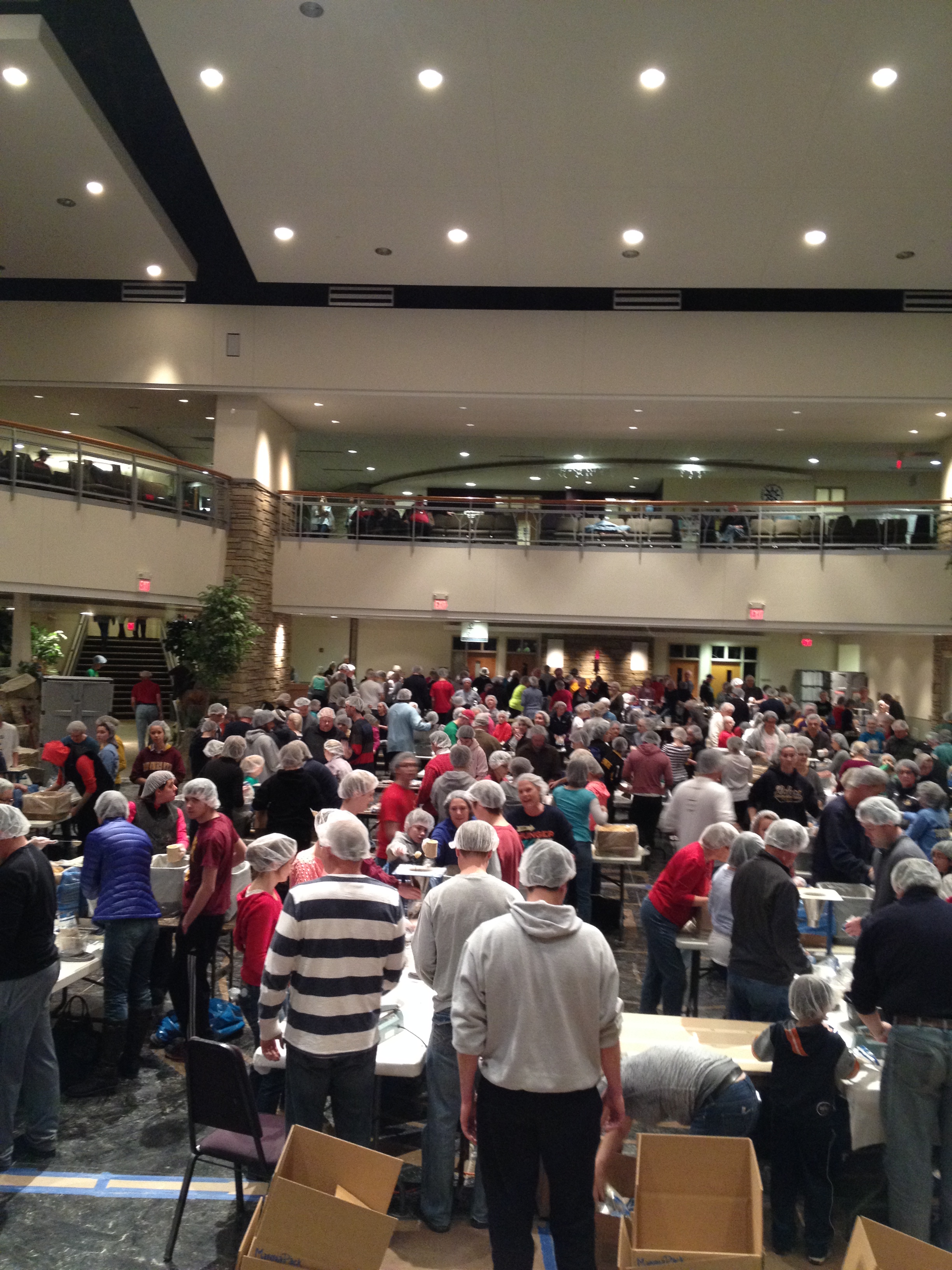
This past week I lived in the heart of the messiness of the church, and as I did, I saw the heart of ministry. Let me tell you one story. For almost a year now, a group of churches in our area have been planning a joint mission project. Week to week, month to month, the number of congregations on board changed. At last count, I think it landed around 20. For those focused on strategy, anyone would tell you having this many people jointly planning an event is a bad idea. The project – pack over 3 million meals for Feed My Starving Children. Have you ever worked with this project? If you have you know, it’s messy. Rice, soy, veggies and protein dust – everywhere. And now we are going to find a place, a church building none-the-less, and pack 3 million meals. That’s crazy messy. Who does that? And not only is the leadership complicated, the packing messy, but this group has to raise money to pay for each of those 3 million meals. At about a quarter a meal, that’s a lot of money to raise.
But here’s the deal. It happened. And today, less than a week after the last bag was packed, the meals are already on their way to Nicaragua to feed hungry kids. And in the process 10,500 people volunteered. Area basketball teams and scouting groups, Rotary groups and Bible Studies small groups, confirmation students and senior adults, public school kids and teachers…all pack into a church sanctuary, Sunday School rooms and fellowship halls to make a mess. (Can’t imagine it – check out this video.)
One of the beauties of this “event” was how chaotic and messy it was. No one tried to control it. Guide it, yes – control it no. We didn’t know how it would happen, because no group had done such an event before. We didn’t know if we’d have enough volunteers to fill all the packing stations at each shift. But each shift meals were packed, one meal for one child, at a time. And at the end of each shift we heard a story, a story about one kid who’s life was changed because of this food. And suddenly it all came together. The number wasn’t 3 million, it was one + one + one.
In a recent blog post, Seth Godin said this, “I think most of us are programmed to process the little stories, the emotional ones, things that touch people we can connect to. When it requires charts and graphs and multi-year studies, it’s too easy to ignore. We don’t change markets, or populations, we change people. One person at a time, at a human level. And often, that change comes from small acts that move us, not from grand pronouncements.” (See Our upside-down confusion about fairness for the full post.)
Change comes from small acts that move us…and church is its best when it drops into the lived experiences of human life. And human lives are complicated, broken…and messy. And that is where the church is called to enter.
I’m thankful for ministry moments which are messy, messy because they connect with people’s experiences and their story. And in the week ahead I’m going to focus less on control and more on small acts that move. Will you join me?
Phil, the compensated celebrity spokesperson for the ELCA Youth Ministry Network, invited me to spend a long weekend in St. Louis. I, along with 650, said yes. (Phil’s the one in the middle and here’s the invite if you want to see Phil in action –
Honestly, it wasn’t convenient. (There were several things going on at work and at home which I had to miss.) But I missed it last year and I needed to go. Why?
First, as many will say (including Tara Ulrich and Organic Youth Ministry) the ELCA Youth Ministry Network Gathering is more than a learning event, it is a network. And while this network is always there – virtually accessible with local and regional opportunities to gather – there’s something powerful about being in a space where the virtual network is physically real.
I’ve been teaching children, youth, young adult and family ministry at Luther Seminary for the past 9 years … and the funny thing about students is…well, they graduate. So one of the coolest things I get to do at this gathering is hear how life and ministry is going today…on the “other side” of graduation. While in St. Louis I had dozens of conversations with Luther alumni, now working in some area of ministry in the first third of life. I heard their joys, and felt their struggles. I listened. We laughed. We worshipped together, and we dreamed about what it means to move the church forward into this new age. These conversations were rich, not only because we reconnected, but because we were now partners in ministry – colleagues and friends.
But that’s not all. For the past several years I have worked with a team of leaders on a church-wide initiative on equipping youth ministry leaders. When we started it was a new concept, never tried before. People were confused and unsure how it would go, but they went with it. Now, three years later, people are coming up to me and sharing really cool stories about how they are using the work of this initiative to empower leaders – adults and youth – in ministry and in integrating their faith into their daily life. The smiles, many accompanied with hugs, tell me their confusion has turned to hope. I love the church. But I also know the church has to rethink it’s frames and approaches to ministry if it is going to faithfully live out its calling. While in St. Louis, I had a glimpse of the change taking place in the church.
And there’s one other thing. Our church, the church I have been part of all my life, is shifting it’s leadership model. Oh, don’t get me wrong…we don’t have it all figured out but we are on our way. And I got glimpses of a new future, a future were leaders are humble, servant leaders with a mission and vision. There is a desire for faith to be alive among God’s people and God’s people to be active in God’s world. For two days after the big gathering, I had conversation with some of these leaders. They, like me, had other places they could have been and other things they could have been doing. But they came together in St Louis to think beyond their stream of work and vision about a new day, a day where our church initiatives are more connected and collaborative. Why? because fostering faith among those in the first third of life – babies, children, youth and young adults – matters!
So today, I’m tired and having a hard time reentering the world I left behind. It’s so easy to get back to the daily tasks…and I will…but I want to reengage in light of what I just experienced. How might my daily work, my ordinary work, keep these ideas alive? How might my decisions, big and small, be part of our larger church’s exploration of what it means to be church in 2014 and beyond? These are just some of the questions which distract and challenge me today.
For those of you who were in St. Louis – thanks for your work. You matter, your work matters and your presence in the ELCA Youth Ministry Network matters. Help me, help us, help each other and the church live our calling. And to those who were not there but are in some way part of this larger network of God’s people seeking to faithfully live their faith everyday…stay connected, both virtually and physically, because it helps fuel the journey.
It was a Sunday afternoon and my daughter and I were running errands. We were halfway between home and a store I wanted to stop by. In a “senior” moment, I asked my daughter if we could stop by home to check on how late the store was open. Before I even realized what I had said, (I wanted to go home and call the store or look up their information on their website) she had taken out her phone, searched for the store and told me we had an hour before they closed.
I grew up in an era with phone books – yellow pages for businesses and white pages for home residents. My mom loved phone books, and she taught her kids well. As the saying goes,”She let your fingers do the walking” and made use of this valuable tool located right in our kitchen cupboard. In the 1980s, phone books were a source of information.
My kids don’t know the difference between white pages and yellow pages, and laugh at the idea that a book, updated once year, could we valuable for getting people’s numbers, findings specialty stores or even discovering a shop’s hours. This information, as witnessed with my daughter, is all at their finger tips. All the time, everyday.
So what, you might ask. What does it matter how one finds phone numbers or store hours?
It matters because the world has shifted. My daughter doesn’t only have access to the yellow pages in her phone, she’s got “the world” in her hands. Think I’m over exaggerating? Think again.
This fall, while said daughter was in a class on Martin Luther, mom became a great resource. For about five Tuesdays or Wednesdays in a row, I’d get a text, email or even a call, asking for help. My daughter was struggling with the assigned reading in her religion class, usually a reading I had in print in my office. She’d written a 2 page reflection, but wanted me to “look it over” and offer critical feedback. (A theologian’s dream – quite possibly!) To offer good feedback, I needed to “refresh” my own reading of these texts. And guess what I did? I Googled it. And, lo and behold, I found the texts I needed. All of them. Imagine that.
Today, all kinds of information is available at our fingertips – in our Smartphones, in our iPads and in our laptops. Getting essays by Martin Luther, for example, is not a problem. The issue at hand is, like it was for my daughter, finding a good conversation partner. What does this mean for faith formation? What does this mean for Christian education?
This experience with my daughter has helped me rethink what it means to be a teacher of the church. Yes, I’m teaching church leaders, but I don’t think it matters if it is a “soon-to-be” pastor or a 13-year old or an educated lay person. Studies show, we can get access to information. But who will be a guide? Who will help people make their way through the maze of information? Who will ask good questions? Who will be there for conversation?
The world has shifted. As one “teaching” about the Bible, theology and what our church believes, I have to remember, I am not the dispenser of information – my role has changed. These days, what’s needed is a guide. one to accompany learners in their journey of faith. I don’t know exactly what that means yet, but I’m trying. And I’m making mistakes along the way.
Two easy things to do to get started:
As you ponder what this means for you, think about an area you don’t know anything about, but want to. (I recently needed help with some aspect of knitting, for example.) Maybe you have a particular “situation” or problem you want to address. Maybe it’s a really big issue, and you want to know how to get started. What did you do? Where did you turn? What would you need? What kinds of questions would you have? Maybe the exploration is a place to begin.
Next, listen. In the “normal” places and in the “abnormal” places. Listen to what people talk about in the coffee hour between services or before or after confirmation. What insights do these comments have for you as you think about being a guide. But also listen at coffee shops, at the basketball game or when you are out to eat. And maybe, just maybe, you’ll get a clue as not only the questions, but what tools these folks need to access the information they are looking for.





 Intersections by Terri Elton